Standing seam vs. exposed fastener, side by side
| Standing seam | Exposed fastener | |
|---|---|---|
| Examples | Double lock, snap lock | Corrugated, TuffRib, PBR |
| How panels attach | Clips hidden under the seam | Screws with rubber washers through the panel face |
| Holes through the panels | None in the open field of the roof | One at every screw |
| Heat and cold | Clips let panels expand and contract | Screws hold panels tight, so movement works on the screw holes |
| Upkeep | Very little | Screws and washers need checking over the years |
| Code minimum slope | 1/4:12 | 3:12, or 1/2:12 with lap sealant |
| Cost | about $8 to $16 per square foot installed on our jobs | Slightly more than shingles |
| BMR warranty | 40 yrs double lock · 30 yrs snap lock | 20 yrs labor and material |
| How we get the panels | Roll-formed on site, one piece eave to ridge | Pre-manufactured, delivered by trailer |
| Best for | Homes, churches, low slopes | Pole barns, shops, warehouses |
Slope minimums: International Residential Code, Section R905.10.2.
Why do exposed fasteners need upkeep?
Every screw in an exposed-fastener roof is a hole sealed by a small rubber washer. Sun, cold and years of the panels expanding and contracting wear those washers down, and screws can slowly back out. Neither happens all at once, which is why leaks on rib-panel roofs tend to appear gradually, often years after the roof went on.
Caught early, the fix is usually simple: new screws and washers where the old ones have failed. Standing seam avoids the problem by keeping its fasteners under the seam, out of the sun and the water.
A real switch: TuffRib to standing seam in Xenia
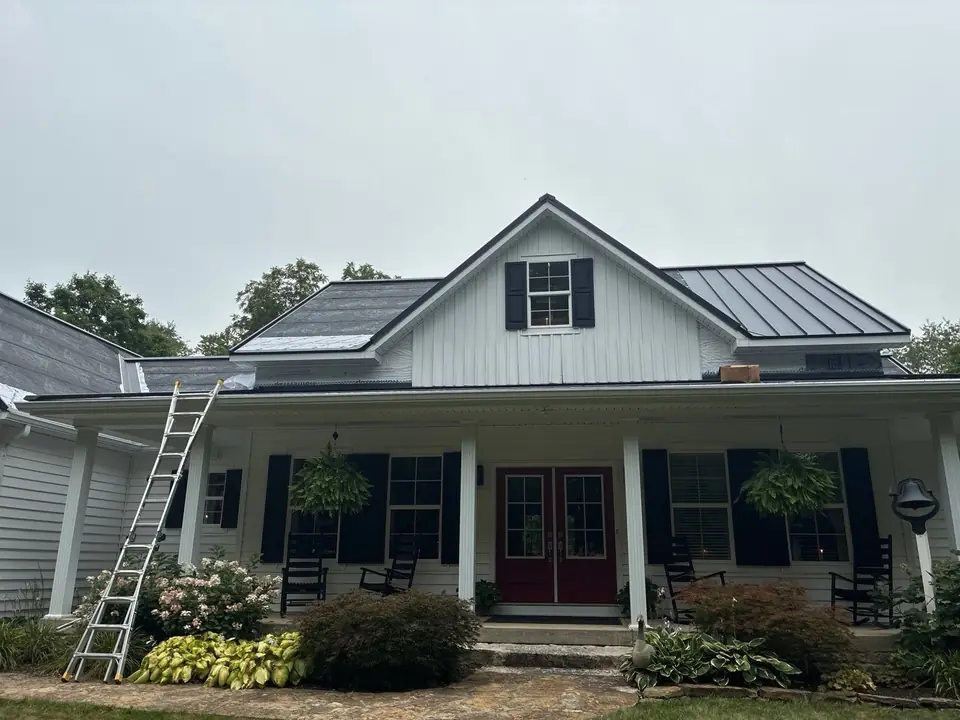
The farmhouse in the photo above, in Xenia, Ohio, had a TuffRib exposed-fastener roof, and the owners wanted the look of standing seam. We took it off completely, pulled siding where needed to set new endwall and sidewall flashings, laid new underlayment over the whole roof, and installed about 5,000 to 5,200 square feet of 26-gauge textured black snap lock standing seam with clips. Partway across one slope the panels began drifting out of line with the rake edge, so the crew pulled about five panels and reset them.
Read the full Xenia job story.
Is corrugated metal the same as exposed fastener?
Corrugated is one kind of exposed-fastener panel, with a rounded, wavy profile. TuffRib and PBR are exposed-fastener panels too, with squared ribs instead of waves: PBR is the standard for commercial and steel buildings, and TuffRib for pole barns and ag buildings. All of them attach the same way, screwed through the face.
Which one should you choose?
- A house you plan to keep: standing seam, for hidden fasteners, the least upkeep and our longest warranty.
- A pole barn, shop or ag building: TuffRib or PBR, which costs only slightly more than shingles.
- A barndominium: often both, with standing seam over the living space and rib panel over the shop.
- A low-slope roof: double lock standing seam.
Our take. We install both standing seam and exposed-fastener panels, so we have no reason to push one over the other. Tell us what the building is for and how long you plan to keep it, and we will recommend the panel that fits. See standing seam roofing or pole barn and commercial metal roofing, or call (937) 423-9352.
Related questions
- What Is the Best Type of Metal Roofing?
- How Do You Fix a Leaking Metal Roof?
- What Is the Minimum Pitch for a Metal Roof?
- How much does a metal roof cost in Ohio?
- All metal roof questions